


Surprising statistic to start: more than 95% of crypto exchange-held assets are typically kept offline in cold storage—but the moment you log in and move a position, your operational security becomes the decisive factor. For US-based traders who use OKX to access spot markets, futures, staking, and Web3 services, the act of logging in is the hinge where institutional-grade infrastructure meets human error, browser risk, and phishing economics.
This article walks through a realistic trader scenario—accessing an OKX account from a US laptop to place a margin trade and move a portion of funds into an on-platform staking product—and extracts practical rules of thumb. You will leave with a clearer mental model of how OKX’s architecture allocates risk, what protections are materially effective, where residual danger lives, and what to watch next if you use OKX for trading and Web3 interactions.
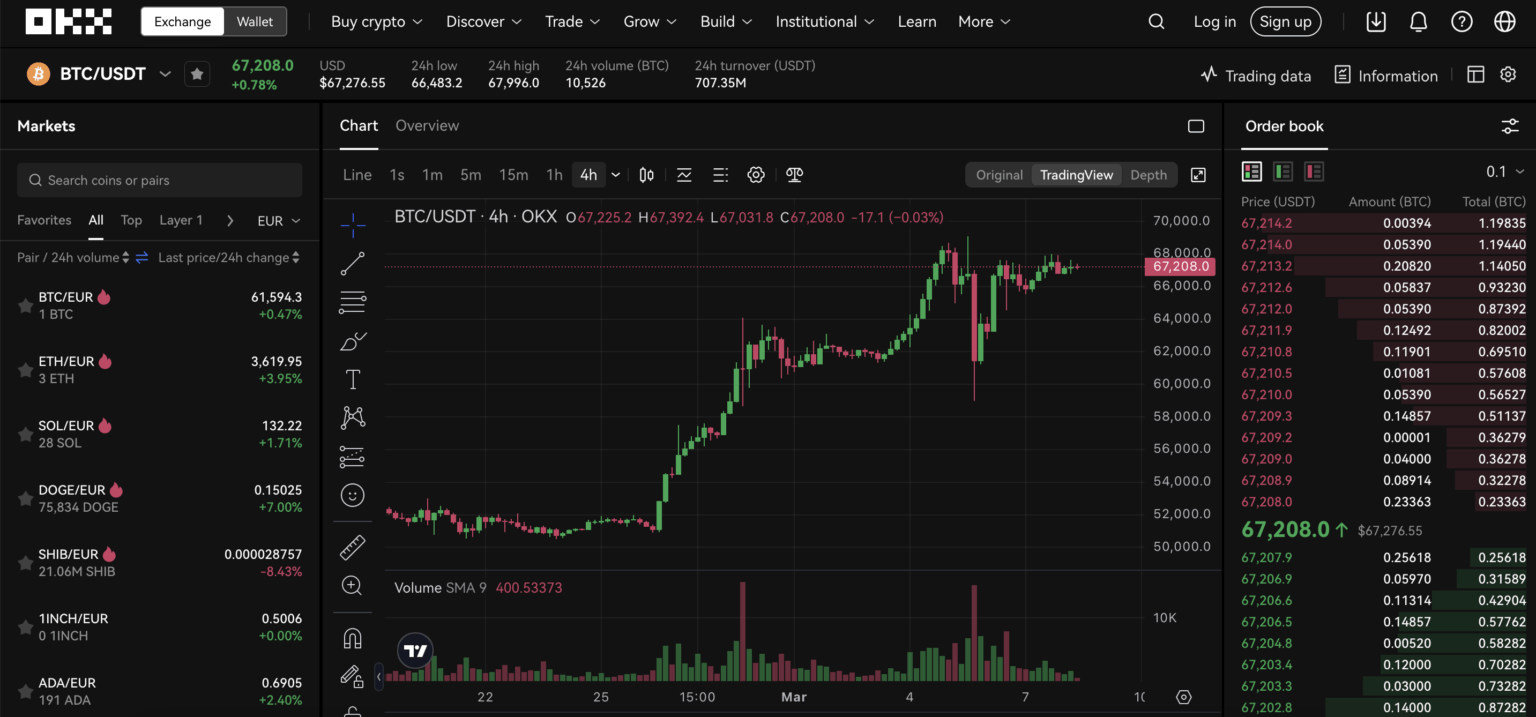
Case scenario: logging in, trading margin, and staking—what breaks and why
Imagine you’re at your desk in the US. You open your browser, head to the OKX web platform, and prepare to trade BTC/USDT on margin while moving idle USDT into a flexible staking product. Mechanisms at work: (1) centralized custody—OKX holds deposited assets in a mix of hot and cold wallets; (2) account authentication—military-grade encryption plus AI-driven login monitoring and mandatory 2FA; (3) cross-product plumbing—CEX order engine, derivatives backend, and Web3 wallet functions integrated into one UI.
Where it can break: phishing pages that mimic OKX login flows, browser extension or clipboard malware that hijacks pasted addresses or seed phrases, SIM-swap attacks that intercept SMS 2FA, and risky smart contracts if you later move assets into DeFi via the integrated DEX aggregator. OKX’s defensive measures—real-time AI detection, mandatory 2FA, and Proof of Reserves transparency—reduce systemic custody risk, but they do not eliminate endpoint risk where you sit with your keyboard.
How OKX’s security design affects the trader’s threat model
Split the security picture into three layers: platform, custody, and endpoint. At the platform layer OKX publishes Proof of Reserves (PoR) and keeps over 95% of assets in air-gapped cold storage with multi-signature controls—these are strong mitigations against the exchange becoming insolvent or having a single hot-wallet compromise. For traders who prioritize capital safety, that design means custody risk from the exchange itself is materially lower than it used to be in the industry.
At the custody layer, OKX also offers a non-custodial Web3 wallet and hardware wallet integrations. That’s a useful option when you plan to interact with DeFi or hold NFTs—transacting from a self-custodial wallet isolates those exposures from your CEX balance. But the trade-off is explicit: self-custody shifts responsibility to you. Lose the seed phrase and recovery is impossible; misuse of a Web3 dApp can still lead to smart contract exploits.
The endpoint layer—your device and network—remains the most fragile. Despite military-grade encryption and AI login checks, what matters in practice is whether a malicious extension or an attacker controlling your DNS can capture credentials, or whether you allow a replacement device into your account via a weak KYC process. For American traders, the practical rule is to harden the endpoint: use hardware keys or authenticator apps instead of SMS when possible, keep recovery phrases offline, and prefer biometrics on locked personal mobile devices rather than shared machines.
Trade-offs: convenience vs. control across OKX features
OKX combines a CEX, a Web3 wallet, an NFT marketplace, and a DEX aggregator in one UI. That integration reduces friction: you can fund a futures position, swap via the aggregator, and stake rewards without copying addresses. Friction reduced often increases convenience but widens attack surfaces: a single compromised browser session may expose multiple functions. The practical heuristic: separate accounts and workflows. Use the exchange for spot/futures, a hardware-backed non-custodial wallet for swapping into DeFi, and the mobile app with biometric login for quick monitoring. That separation increases workflow friction but lowers correlated failure modes.
Leverage products (up to 125x on some derivatives) are another classic trade-off: high leverage provides asymmetric payoff potential for directional traders but drastically increases liquidation risk and slippage exposure. For US traders, regulatory friction and KYC also shape usability—ID and live facial checks are required, which reduce anonymity but increase recoverability if account theft occurs under certain conditions. Accepting KYC is a trade of privacy for recourse.
One sharper mental model: “custody perimeter” and how to manage it
Think of your total crypto exposure as a set of concentric perimeters. Innermost is exchange hot-wallet balances (needed for active trading). One layer out is exchange cold storage (institutional risk absorbed by OKX). Next is your non-custodial wallet (you control keys), and finally off-platform DeFi allocations and NFTs. Your defensive strategy should be perimeter-aware: minimize capital in the inner perimeters unless actively trading, increase diversification of custody types for larger allocations, and use hardware wallets when moving significant value to self-custody or DeFi.
Heuristic to reuse: “Active funds < 10%, Reserve funds > 90%”. This is not a rule of law—it’s a starting allocation to think about where you tolerate operational risk. Active funds live on the exchange; reserves sit in hardware-backed wallets or diversified cold storage. Adjust the percentages to fit your risk tolerance and trading frequency.
Operational checklist before you log in
Before you click to log into OKX from any device, run this short checklist: confirm the URL or use a saved bookmark, disable unnecessary browser extensions, ensure 2FA uses an authenticator or hardware key instead of SMS, confirm your device’s OS is up to date, avoid public Wi‑Fi or use a trusted VPN, and if you expect to use Web3 DApps, use a dedicated browser profile or hardware wallet. For convenience, OKX’s mobile app includes biometric login; use it for monitoring but keep trading of large sizes to a secured desktop environment with hardware 2FA.
If you want to sign in now, the platform provides a standard login flow—here’s the official link for access: okx sign in. Use it as a single point of entry and pair it with the checklist above.
Where the model breaks and what to monitor next
Two important boundary conditions. First, Proof of Reserves proves backing at a point in time but does not guarantee operational continuity or immunity to regulatory seizure. It helps with transparency but is not a panacea. Second, OKX’s DEX aggregator and staking products expose you to smart contract risk that PoR does not cover. If you move funds from the CEX to DeFi, you trade exchange custody risk for protocol risk—each has different failure modes and recovery prospects.
Signals to watch in the near term: changes in PoR reporting cadence or method, shifts in custody percentages between hot/cold wallets, and any updates to 2FA options (for example, broader support for hardware security keys). Also monitor aggregated liquidity conditions—slippage and wide spreads on low-volume assets are predictable when volatility spikes, and OKX’s aggregator will route across DEXes where smart contract risk varies.
Decision-useful takeaways
1) Treat login as a security-critical operation: harden your endpoint and prefer non-SMS 2FA. 2) Use a perimeter model: keep only what you need for active trading on the exchange; move reserves to self-custody with a hardware key. 3) Understand the swap: moving from CEX to DeFi replaces exchange custody risk with smart contract and bridge risk—do not conflate Proof of Reserves with safe DeFi exposure. 4) When trading derivatives, size positions to limit liquidation probability and pay attention to liquidity under stress, not just nominal leverage numbers.
These rules are practical because they tie actions (how you log in, where you store assets, when you use leverage) to mechanisms (authentication entropy, multi-signature cold wallets, and automated market microstructure). They are not a guarantee—no set of practices removes risk entirely—but they channel your decisions toward controllable variables.
FAQ
Is OKX safe for US traders?
Safety is a combination of platform controls and your operational security. OKX has strong institutional controls—PoR, cold storage, AI-driven login monitoring, and mandatory KYC—which lower systemic exchange risk. However, your endpoint practices and choices to move funds into DeFi or use high leverage are the primary determinants of your personal safety.
Which 2FA method should I use for the best trade-off between convenience and security?
Hardware keys or authenticator apps (e.g., Google Authenticator) provide better security than SMS because they prevent SIM-swap and remote interception attacks. Biometric logins on your mobile device are convenient for monitoring but pair them with a hardware key for high-value transactions.
Can Proof of Reserves replace personal custody practices?
No. PoR increases transparency about the exchange’s backing of deposits, but it does not protect you from phishing, endpoint compromise, or smart contract exploits after you withdraw funds. Consider PoR as one signal in a broader custody decision framework.
When should I use OKX’s non-custodial wallet instead of the exchange?
If you plan to interact with DeFi, mint or trade NFTs, or retain long-term holdings, a non-custodial wallet with hardware integration gives you control and lowers custodial counterparty risk. Use the exchange when you need instant liquidity or leverage for active trading—but move longer-term holds off-exchange.

